The Study That Made Me Realize I Was Aging Myself
|
By Vishen Lakhiani | Jan 28, 2026 |
Two weeks ago, I turned 50. And I caught myself doing something subtle… but dangerous. I was ageing myself. Not biologically. On paper, I'm doing great. Most longevity and biomarker tests place me 10 to 20 years younger than my chronological age. My body is strong. My health is solid. But mentally? I had started building a quiet list of excuses. When my son Hayden, who somehow speaks seven languages, asked why I wasn't learning Spanish and Italian, my answer came out automatically: "Well, you've got a teenager's brain. It's easier for you." When my kids invited me to join them in new physical practices, I'd hesitate. "My wrists aren't as solid."
"My recovery isn't what it used to be."
"That's easier when you're younger." None of this sounded dramatic. It sounded… sensible. But taken together, it formed a pattern. I wasn't listening to my body.
I was talking it into decline. And then I read a fascinating study by Ellen Langer that completely messed with my worldview. |
|
|
The Study That Was Almost Never Published
|
This study was conducted in 1979. And here's the part most people don't know: The results were so wild that Langer hesitated to publish them. She feared the scientific community simply wouldn't accept what she'd found. At the time, the idea that belief, identity, and mindset could meaningfully alter physical ageing was considered fringe, if not outright heretical. Today, with what we now know about meditation, placebo effects, neuroplasticity, stress biology, and longevity science, her findings are far easier to digest. But back then? They sounded impossible. And yet, they happened. When you read this study — really read it — I guarantee it will change how you think about your age and your life. Here's what she did. |
|
|
The Counterclockwise Experiment
|
Langer took a group of men in their late 70s — some close to 80 — and brought them to a retreat. No supplements.
No exercise program.
No medical interventions. Instead, she recreated the world of 1959. The furniture.
The music.
The magazines.
The radio broadcasts.
The conversations. The men weren't asked to remember 1959. They were instructed to live as if it were happening now. They spoke in the present tense about events from that era.
They carried their own luggage.
They weren't treated as fragile or dependent.
They were treated as fully capable men in their prime. And then Langer measured them — before and after. What happened next still makes people uneasy. |
|
|
What Changed in Just One Week
|
After only seven days, measurable biological and physical shifts occurred. Not opinions.
Not feelings.
Measured changes. Their posture improved.
Several men stood taller, reversing the hunched posture we associate with ageing. Their strength and flexibility increased.
Grip strength improved. Movement became easier and more fluid. Their memory and cognitive performance improved.
Standardized tests showed real gains. But here's where it gets truly mind-bending. Their eyesight improved.
So much so that some of the men were told they needed new glasses. Not because their vision worsened —
But because it got better. And then there's my favorite detail. Their fingers got longer. No — their bones didn't grow. What happened was this:
Inflammation in their finger joints reduced. As swelling decreased, the fingers could extend more fully. Mobility returned. Measurable length increased. Ageing had been masquerading as inevitability.
But it turned out to be, at least in part, reversible signaling. Even independent observers noticed. When people who didn't know the experiment were shown before-and-after photos, they consistently rated the men as looking younger at the end of the week. No drugs.
No devices.
No hacks. Just a shift in identity and expectation. |
| |
The Part That Hit Me Hard
|
Here's the implication I couldn't ignore. These men didn't "fix" their bodies. They changed how they related to themselves. They stopped behaving like old men — and their biology followed. That's when I realized something uncomfortable. I wasn't being limited by my health.
I was being limited by my self-talk. |
|
| So I Changed the Rules at 50
|
Here's what I decided as I crossed this milestone. I stopped telling myself I was too old. I'm learning Spanish and Italian.
I'm picking up skills I once believed had expiration dates.
I'm experimenting with new fitness protocols weekly. Through ClassPass, I'm trying practices I once avoided — Pilates, yoga, and new movement systems. And I'm shocked at how rapidly my body adapts. Most of all, I've returned to martial arts. At 17, I was an international fighter with a double black belt in taekwondo. Competing at the U.S. Open and training at the Colorado Springs Olympic Training Center shaped my discipline — and my life. Then I stopped. Not because I had to.
Because I told myself I was "too old." So I'm back. Working on flexibility. Practicing kicks and forms. Chasing a full split again — yes, like Jean-Claude Van Damme in Kickboxer. I've even redesigned my living space so movement is always within reach. Between meetings, I jump up, stretch, drop push-ups, and practice kicks. Not because I'm chasing youth. But because I refuse premature decline. |
|
|
How You Talk to Your Body Matters
|
What Langer later showed — in another Harvard study — is just as powerful. She found that how you talk to your body can sometimes have a greater effect than what you give it. Your body is always listening. Every decision is a conversation. When you say,
"I'm too old for this,"
You're talking to your body. When you say,
"Let's try this,"
You're talking to your body. When you experiment with a new movement practice,
When you challenge an old belief,
when you act like possibility is still open — You're talking to your body. The question is: What kind of conversation are you having with yours? |
|
|
Why I Can Do All This Now
|
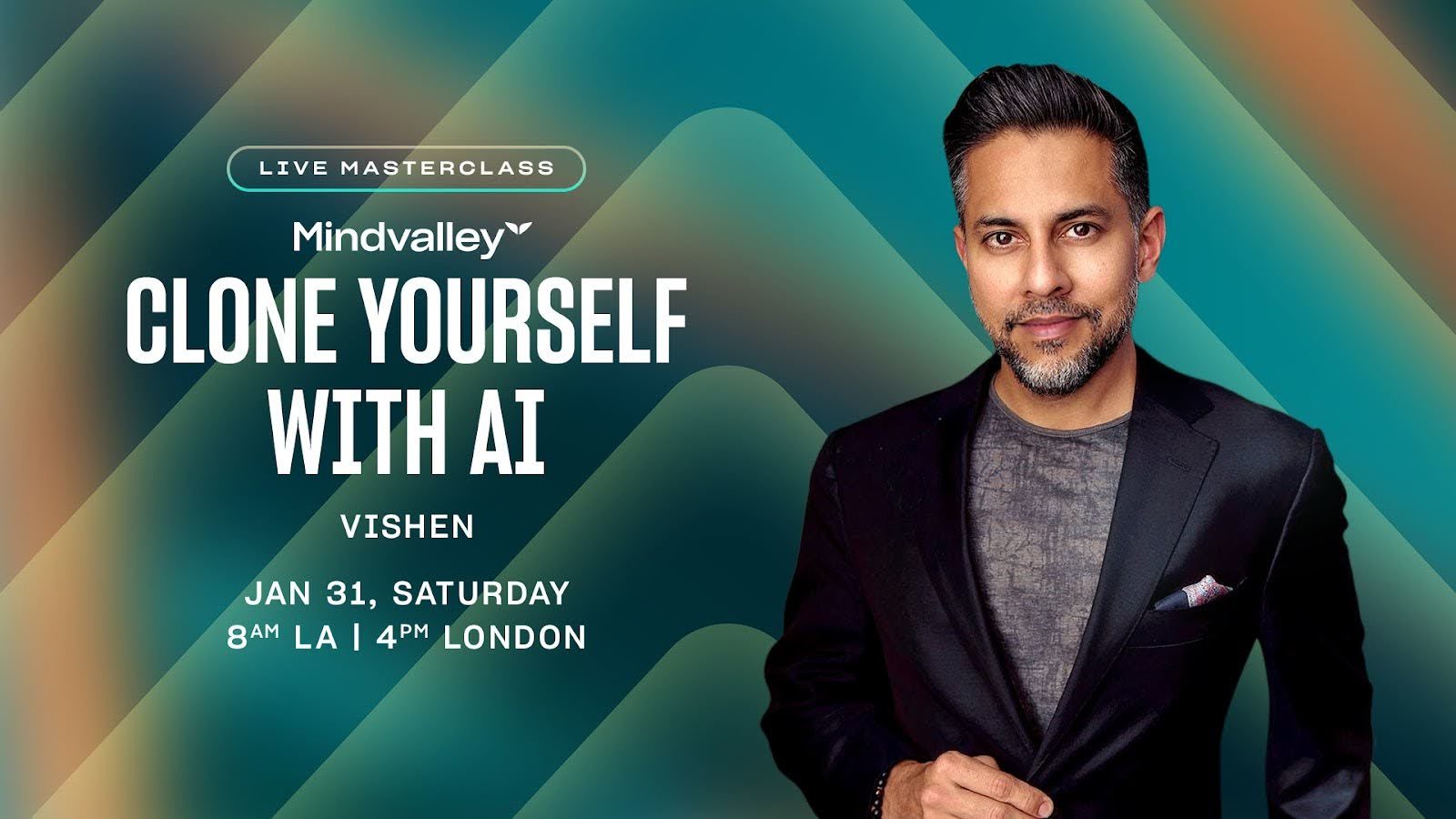
What's allowing me to explore all these health practices and return to martial arts is that I've radically changed how I work. By using AI to clone how I think, decide, and create, I've gained 50× leverage. What used to take me 50 hours now takes one hour. As a result, I'm starting new companies and taking a week off every month just to enjoy life. I'm taking classes in stand-up comedy, music, and languages. I'm travelling more. And I'm finally making time for my body. If you want to learn how to create that kind of time, so you can actually add health, movement, and exploration back into your life, I'm teaching a class on cloning your brain with AI. |
I'll show you the exact workflows I use to create 50× leverage. And then? I invite you to join me in this adventure. Stop ageing yourself. Try something new this week. Your body is listening. — Vishen P.S. If this sparked something in you — a question, a realization, or even resistance — leave a comment on the blog. Your reflections shape what I explore next. |
|
|
 Mindvalley Inc, 407 California Avenue,
Suite #2, Palo Alto, CA 94306, United States |
| |
|
|



No comments:
Post a Comment