|
|
We recently asked founders how they use AI.
|
65% said they only use it for writing or one-off tasks. A quick email. A caption. Something they used to search on Google.
|
Most people are using a tool that can build a business… to write an IG caption.
|
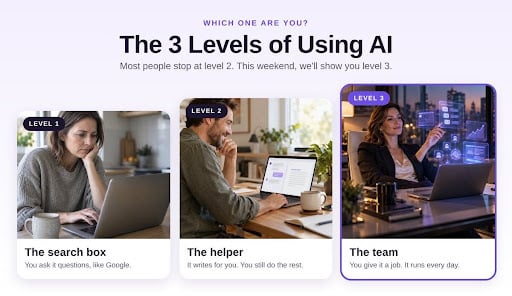
I’ve noticed there are three levels to using AI. See which one you’re on.
|
Level 1: The search box. You ask it questions, the way you’d use Google. Useful, but it’s the smallest thing it can do.
|
Level 2: The helper. You ask it to write things for you: an email, a post, a summary. You still do all the work around it. This is where most people stop.
|
Level 3: The team. You give it a job, not a question, and it does that job every day. What you get: a business that grows without depending on you for everything.
|
| • |
More clients: AI helps you sharpen your offer, build a website that communicates it, and turn one idea into a month of content that reaches buyers. |
|
| • |
More sales: AI responds to new leads, answers questions and follows up, so interested people don’t go quiet. |
|
| • |
More time back: AI handles the reports, the follow-ups and the recurring tasks, while you make the decisions. |
|
The jump from level 2 to level 3 isn’t a technical one. It’s a different question.
|
Level 2 asks: “Can you write this for me?” Level 3 asks: “Can you do this for me, every day, without me?”
|
I made that jump myself. A few weeks ago I spent four days travelling through two countries, barely in the office, and Mindvalley moved faster than when I’m there. Last week I built a working app in about eight hours, using WhatsApp on my phone.
|
And level 3 isn’t just for CEOs.
|
If you coach, consult, freelance, or have a job and an idea you keep coming back to, it’s the same jump.
|
What if AI could help you find more clients, grow your business, and get your time back?
|
Not another event telling you AI will change everything. 3 days of watching AI actually do useful work in real businesses, built in front of you, step by step.
|
For four years, Mindvalley’s AI Summit has been where more than 170,000 people came to learn AI, most of them with zero tech background.
|
This year, to help founders, coaches and entrepreneurs put AI to work in their businesses, we went back through four years of summits and invited our highest-rated AI teachers: the people our community rated best, year after year.
|
One of them, Noelle Russell, was named Best Trainer of the Year at the 2026 Mindvalley Awards.
|
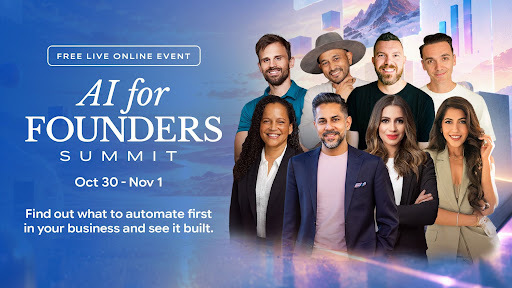
This summit happens this weekend, Friday Oct 30 – Sunday Nov 1, 3 days, live on Zoom, 100% free.
|
What you’ll learn at AI for Founders Summit:
|
| • |
How to build a website that actually converts better than your current website, live, in about 45 minutes |
|
| • |
How to create a month of content from one idea, in your own voice |
|
| • |
How to run your ads with AI, where every dollar you spend has higher return |
|
| • |
How to craft the offer your customers actually want |
|
| • |
How AI can follow up with every lead until they book |
|
| • |
How to turn customer stories into recurring revenue |
|
| • |
How to run a business on AI, end-to-end from first enquiry to delivery |
|
| • |
How to build your first AI team of helpers for research, reporting, scheduling and support |
|
| • |
See your whole business on one screen with an AI CEO dashboard |
|
…and much more, taught by 8 of our highest-rated AI teachers: Vishen Lakhiani, Noelle Russell, Vykintas Glodenis, Marisha Lakhiani, Sara Davison, Tyler Fisk, Ajit Nawalkha and Joe Stolte.
|
Sign up and get an agenda matched to your business.
|
So here’s my question for you:
|
What if these 3 days changed the way you run your business?
|
No jargon. No overwhelm. No tech skills needed.
|
P.S. Quick test: look at what you used AI for this week: If it was all questions and writing, you’re on level 1 or 2. Come and see level 3 this weekend. It’s free, it’s live, and it only happens once a year. Sign up for the summit here
|
|

Mindvalley Inc, 407 California Avenue,
Suite #2, Palo Alto, CA 94306, United States
|
|
|
|