“S.P.E.A.K. Like a Master: 5 Moves That Light Up Any Room”
|
Here's the thing about standing ovations: they're not like regular applause. They're rare. Genuinely rare — the kind of moment where people are on their feet before you've even finished your last sentence, and you can feel the energy in the room shift into something electric. They used to catch me off guard. Now? They're showing up at nearly every talk I give.
The difference isn't charisma. It isn't years of experience. It's a formula.
A five-step framework called S.P.E.A.K — and today, I'm handing you the keys.
Credit where it's due: this formula is inspired from Eric Edmeades, who's leading our free Speaking & Influence Summit this week (June 26–28). He taught me these deceptively simple moves, and they've become my personal "speech GPS." I've taken Eric's original model and adapted it to my own style over dozens of stages. What I'm sharing here is the essential version — copy it, adapt it, make it yours.
Ready to SPEAK magic? Let's go.
|
|
|
- Startup founders pitching investors and craving that "where do I sign?" energy in the room
- Team leaders tired of watching eyes glaze over on Zoom calls
- Aspiring keynote speakers who want to stop settling for "pretty good" talks
- Anyone with a message that deserves to land — and ignite real change
|
If you've ever walked off a stage (or off a Zoom call) feeling like your best ideas somehow got lost in translation... you're exactly who this is for.
|
|
|
Five moves. One flow. Zero fluff. A blueprint your audience will feel in their bones.
|
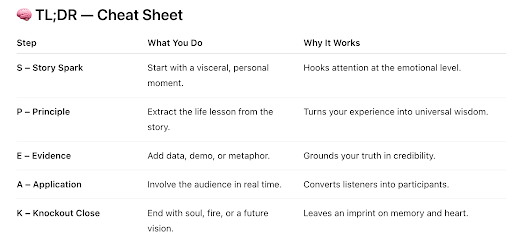
- Story — Spark attention with a vivid, emotionally charged anecdote
- Principle — Crystallize your lesson into one golden, quotable insight
- Evidence — Satisfy the skeptics with proof tight enough to hold
- Application — Turn theory into action with a live micro-experience
- Knockout Close — Deliver a finish that lingers long after the applause fades
|
Simple, right? But let's go deeper.
|
|
|
Why it matters: Stories hijack the brain's attention circuits before the rational mind can object. Before your audience decides whether they agree with you, they feel you — and that's where trust begins.
How you do it: Choose an anecdote — personal or borrowed — that crackles with emotion. Don't just narrate; dramatize. Bring in the sounds, the smells, the sweaty palms. Drop your audience into the scene and stop at the emotional peak — right before the resolution, when tension is highest.
Example: Imagine you're speaking about overcoming procrastination. You open with the night you binge-watched three seasons of your favorite show instead of working on that project that actually mattered. You describe the guilt sitting like a lead weight in your chest. The clock ticking like a metronome mocking your delay.
The moment you almost hit "submit" — but didn't.
That's where you pause. That's where you have them.
|
|
|
Why it matters: Once you've lit the emotional fuse, your audience craves meaning. The Principle is the distilled insight — the thing they'll carry home, repeat to a friend, and maybe tattoo on their soul.
How you do it: Boil your entire takeaway into one crisp, spicy line. Something quotable. Something that reframes how they see the world.
Example: From that binge-watch story:
|
“Momentum builds the minute you decide to start.”
|
That one line reframes guilt into power. It doesn't lecture — it liberates. That's the job of a great Principle.
|
|
|
Why it matters: Inspiration without proof feels like empty hype. Evidence is what bridges the gap between "that's a nice idea" and "I actually believe this." It's what turns a motivational moment into a conviction.
How you do it: Mix three flavors of proof:
|
- Data point — a statistic that surprises or validates
- Case snippet — a real human story that makes it tangible
- Metaphor — an image that makes it stick
|
Example for our momentum principle:
|
- Data: "Stanford neuroscientists found that completing small tasks triggers a dopamine release that fuels motivation for bigger ones."
- Case: "My colleague Laura committed to writing just five minutes on her novel every morning. Six months later, she had 40,000 words."
- Metaphor: "That first sentence is the spark that lights your entire creative bonfire."
|
Three angles. One truth. Bulletproof.
|
|
|
Why it matters: Knowledge that stays in the head is wasted knowledge. Action is what cements transformation — and the best speakers don't just teach, they create the experience right there in the room.
How you do it: Give your audience a bite-sized exercise they can do right now — no heavy thinking required, just momentum.
Example exercise (2 minutes):
Pull out your phone. Set a timer for two minutes. Open a blank note and type: "One small task I've been avoiding is…" Then write the very next physical step to start it. Just one step. Hit done.
Notice how your mind shifts — from stuck to moving.
That tiny win turns the Principle from an idea into a lived experience. And lived experiences change people.
|
|
|
Why it matters: Your final lines are what echo in people's minds long after they've left the room. They're what gets quoted, shared, and remembered. A weak close wastes everything that came before it.
How you do it: Circle back to your opening story or Principle — then elevate it. Use a bold challenge, a poetic image, or a vision of who they could become. Leave them with something that lingers.
Example:
"Tonight, when your head hits the pillow, remember: that one-sentence victory you wrote this morning is a gateway. It proves that the smallest step can lead to the grandest journey. Now go tip over that domino — your future self is counting on it."
That's not just a close. That's a send-off.
|
|
|
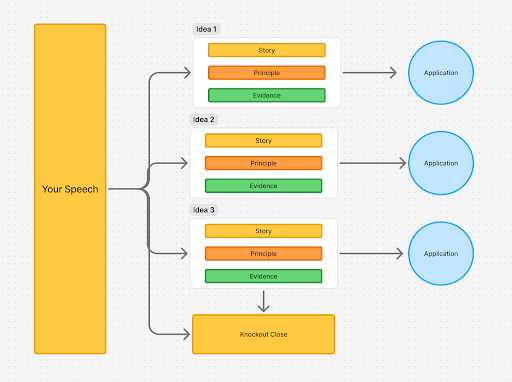
Here's the full arc of a masterful talk:
|
- Open with your Story — hook them emotionally before their rational mind can resist
- Deliver your Principle — give them the insight that reframes everything
- Back it with Evidence — data, case, metaphor — make them believers
- Create an Application — turn insight into action, right there in the room
- Land your Knockout Close — circle back, elevate, and send them into the world changed
|
Format your talks with clear transitions between each move. Use pauses after your Principle. Let the Application breathe. And always — always — earn your close.
|
|
|
Beyond SPEAK: The Art & Science of Masterful Speaking
|
Of course, S.P.E.A.K is just the beginning. Each of these five moves is an art form in itself:
|
- Storytelling: Steve Jobs said it best — "The most powerful person in the world is the storyteller. The storyteller sets the vision, values, and agenda of an entire generation." Crafting narrative arcs, finding your unique voice, weaving emotional through-lines — these are skills honed over years, not afternoons.
- Principles: How do you architect a genuine mic-drop moment? It's about tonality, pacing, the unexpected twist in your phrasing — techniques that take real practice to master.
- Evidence: Transforming cold data into mesmerizing drama takes rhetorical flair and strategic delivery. There's a world of difference between citing a statistic and making it land.
- Application: From transformational experience design to social-proof frameworks and live audience activation — there's an entire science to turning a two-minute exercise into a breakthrough.
- Opening & Close: Mastering the emotional arc of a talk — magnetic hooks, knockout openings, encores that send people to their feet — is a craft that deserves hands-on feedback and live practice.
|
If you're thinking "wow, there's so much more under the hood" — you're right.
S.P.E.A.K gives you an immediate roadmap. But masterful speaking — the kind that turns a room silent, then sends it to its feet — is something you learn best live, with the people who've spent their lives mastering it as your guides.
Which brings me to exactly why I'm writing to you today.
|
|
|
Your Next Move : Only 48 Hours Left to get your free spot
|
Everything you just read is yours to use — right now, today, in your next talk.
But here's what I know after two decades on stage: reading about speaking and becoming a speaker are two completely different things. The fastest way I know to close that gap is to be in the room while it's taught live, by people who've done it thousands of times.
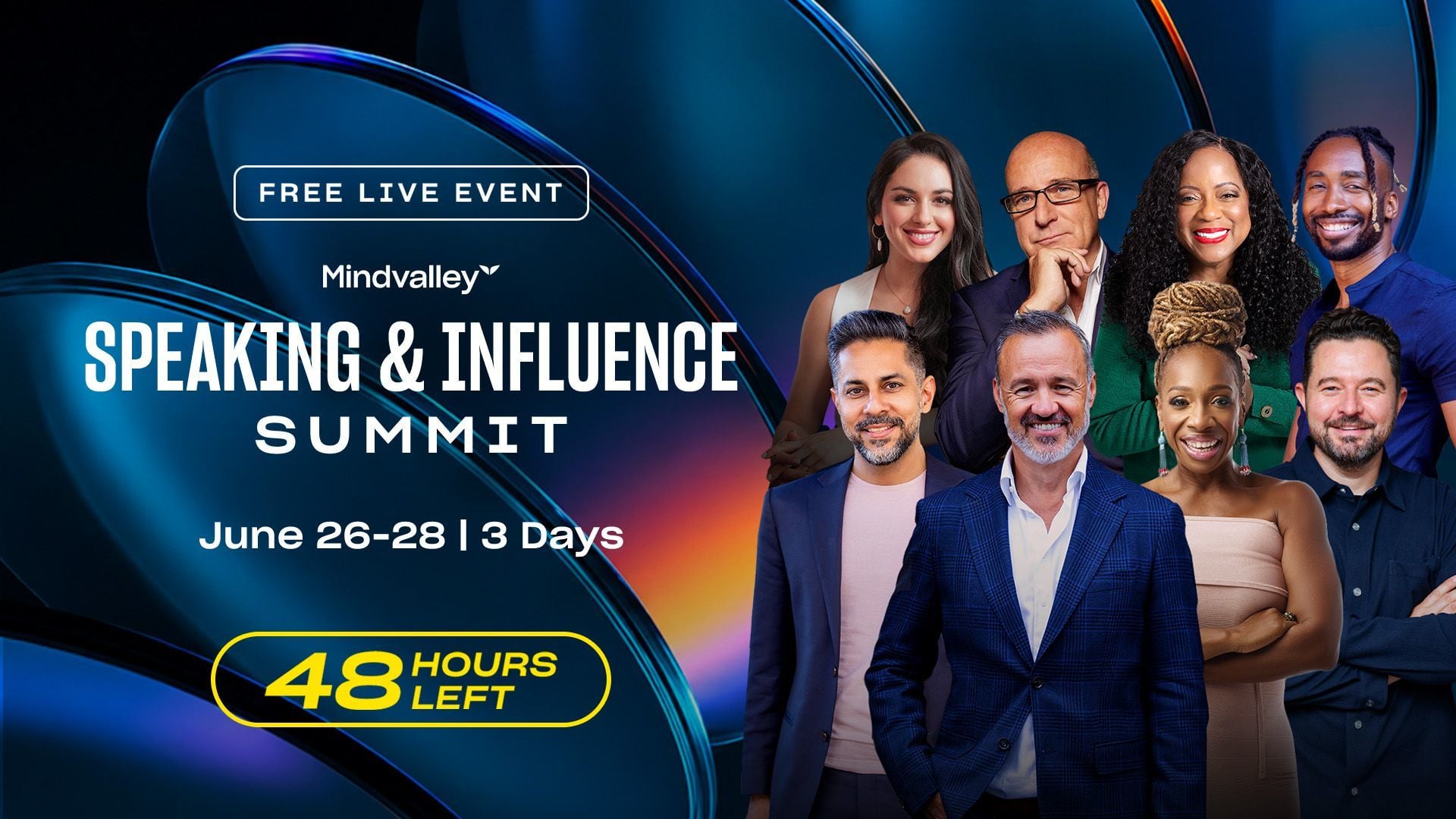
That's why I want you with us at the Speaking & Influence Summit — and right now, you have less than 48 hours before the doors close.
Here's why this is really about: you.
The idea you've been carrying and never quite found the words for. The video you recorded six times and never posted. The room you walked out of knowing you had so much more to give — if only you'd had the tools.
Over three days, we're going to fix how you speak and build your influence — together, live, in real time.
You'll learn:
|
- How to walk into any room and hold it.
- How to tell a story that moves people to act.
- How to speak with the kind of calm authority that makes people lean in and say yes.
|
And you'll learn it from the very best in the world — Lisa Nichols, Eric Edmeades, Daniel Priestley, Prince EA, Paul McKenna, Shadé Zahrai — and me.
Here's the part I love most: it costs you nothing. Completely free. Three days of training that most people spend years and thousands of dollars chasing — yours, on the house, because I genuinely believe the world needs to hear what you have to say.
You've got the message. Let us help you deliver it so it actually lands.
👉 Claim your free seat — only 48 hours left
To your growth in life & business,
Vishen
|
|
|
PS: Which part of SPEAK stood out to you? Drop a comment here — I read them all. And if you want to go deeper, you know where to find us this week. 😉
|
|
|

Mindvalley Inc, 407 California Avenue,
Suite #2, Palo Alto, CA 94306, United States
|
|
|
|
|



No comments:
Post a Comment