Now let me tell you how it happened, and why I'm sharing this with you, especially today.
So the book opens in a hotel bar in Calgary, 2009. In a few hours, I'm going on stage right after the Dalai Lama, in the slot they keep for the speaker nobody came to see, and I'm so nervous that a shot of vodka from the lobby bar feels like a professional decision.
Now think about that for a second. A holy man and a shot glass. Those two things do not belong in the same sentence, and the moment they are, your brain needs to know how it ends. Do I embarrass myself? Do I get banned from Tibet? Does His Holiness join me for one? You turn the page.
And by the time you've found out, I've started something else you need to finish.
That's called an idea collision.
Idea collision: two ideas that don't belong together, forced into one story.
And here's the thing. It wasn't the only one. When I went back through the first eleven pages of that book (The Code of the Extraordinary Mind), I found a whole system in there that I'd built without knowing I was building it.
There's a move I call the unsell, where I tell you on page one that you might hate this book, and the reader who was about to drift has just been dared to stay. There's the thing you can't unsee, a promise that the book will change you, not inform you.
There are open loops, every one with an address, a chapter number where it closes. There's phraseology, the new words, more than twenty of them, so you have a handle to carry each idea out of the room by. And there's the slippery slope, short sentences where each one makes the next unavoidable.
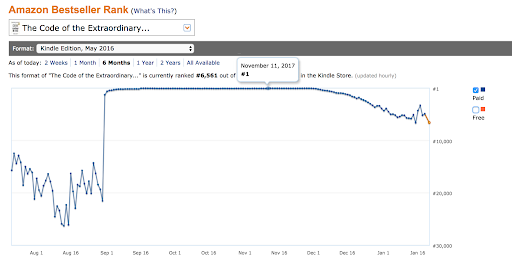
Now, why eleven? Because every so often Amazon gives a book away free to thousands of its premium members, and most of those books get skimmed and shelved, so Amazon only counts a book as read once you get past page eleven. Amazon didn't read my book. It counted. And almost everyone who opened it got past page eleven, because that's where the system lives. The ranking had to move. It moved all the way to the top.
Let that sink in for a second.
The ideas got the book written. The system got it read.
And I believe this is the thing nobody teaches experts.
You spent years getting good at your idea. Nobody spent one afternoon showing you how to make a person turn the page. It's not luck, and it's not talent. There's a structure. And once you see it, you can't unsee it.
So here's why I'm telling you this today.
At the Expert to Authority Summit, starting this Friday (Sep 18), I break the whole thing down. Not just how to write a book that's sticky. How to build courses, content, and books that people finish, that turn readers into fans.
This is how Mindvalley has accumulated 26,000 case studies from students who willingly share their stories of transformation.
Here's what happens in the room.
Friday: Sep 18
I open with why most experts stay invisible. Marisa Peer on the moment she stopped being a practitioner and became an authority. Then you draft your own signature method, live, name and all. It will be rough. That's the point.
Saturday: Sep 19
One idea turned into thirty days of content, built live with AI. The email machine. The product step ladder. Ajit Nawalkha takes four to six people through their positioning and their method name, on stage, in front of everyone.
Sunday: Sep 20
Daniel Priestley on the weekly cadence that builds an audience whether you feel like it or not. The funnel that runs without you on the call. Regan Hillyer, fireside. Then I take real expert funnels apart, live.





No comments:
Post a Comment